Music Hall to Television: How the Variety Bill Changed
Music hall to television variety changed with its venues and technology; trace named turning points and see how each reshaped the acts audiences encountered.
The common mistake in tracing the variety bill is to treat music hall, vaudeville and television variety as interchangeable names for a parade of acts. That flattens the history: each form belonged to particular venues and technologies, and the shift from one to another changed who presented the acts and how audiences encountered them.
Music hall to television variety is not a straight line of improvement. The sequence runs through overlapping traditions, including British music halls, American vaudeville, radio and television. Each retained the appeal of distinct performances while adapting the bill to a different setting.
What did the Victorian music hall put on stage?
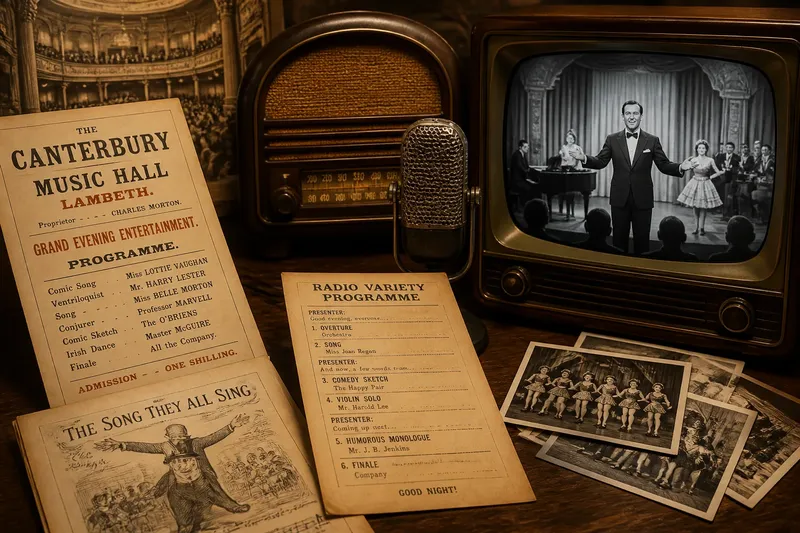
British music halls took shape in the nineteenth century, growing from music rooms attached to public houses into purpose-built venues. By the later Victorian period, performers could appear in large halls such as the Canterbury Music Hall in Lambeth, opened by Charles Morton in 1852. Such venues offered an evening of separate acts rather than a play with one continuous plot.
A bill might include comic songs, singers, instrumentalists, dancers and novelty turns. The acts had to make their identities clear in a room where food, drink and audience noise could compete with the stage. A song with a recognisable refrain or a performer’s established comic persona helped an audience grasp the attraction quickly.
Music hall was also a commercial and social institution, not simply a style of performance. Audiences bought admission to an evening’s entertainment; proprietors assembled the bill, and performers worked within the conventions of a particular venue. The acts could be varied, but their order and presentation were shaped by the practical business of keeping an evening moving.
How did American vaudeville differ?
In the United States, vaudeville developed as a related but distinct form of commercial variety entertainment during the late nineteenth century. Theatre circuits helped standardise the presentation of multiple short acts, and performers could travel between venues under booking arrangements. The result was not a copy of British music hall: the institutions, audiences and local traditions differed.
Vaudeville bills could combine comedians, singers, dancers, acrobats and other speciality performers. The range of turns made the programme itself the attraction, while the running order offered a succession of different performance styles. The bill might be assembled for a particular theatre or circuit, rather than shaped around a single narrative.
The distinction matters because “variety” describes a broad organising principle, not one uniform historical form. Music hall and vaudeville both brought separate attractions together, but their venues and booking systems gave them different working conditions and identities.
What changed when variety reached radio?
Radio variety transferred the bill from a shared room to a broadcast schedule. The microphone favoured acts that could communicate without relying on a visible gesture: singers, musicians, comedians and storytellers all had a place, while the presenter’s voice could introduce one turn and mark the next. The audience no longer watched performers enter and leave a stage.
Broadcasting also made timing and continuity part of the production. A radio programme could use spoken introductions, music and planned transitions to move between contributions. The audience heard a sequence assembled for transmission, not the physical clearing of a stage. The old variety principle remained, but the medium supplied its own means of connecting acts.
Why did television variety develop its own conventions?
Television brought performers into the home and made visual presentation available to the production team. A camera could frame a singer closely, show a dancer’s movement across a stage or direct attention to a host. Sets and studio layouts could provide a recognisable setting, while editing and broadcast production controlled what viewers saw and when.
British programmes such as The Good Old Days, first broadcast by the BBC in 1953, deliberately evoked music hall conventions. Its period setting and audience participation presented an interpretation of music hall for television, rather than transferring an original Victorian bill intact. The programme is a useful example of how a later medium could quote an earlier entertainment tradition while reshaping it for its own audience.
Television variety did not have one fixed format. Some programmes centred on a host, others on a particular performer, and some assembled a succession of guests and speciality acts. The camera and studio were not neutral containers: they affected how an act was introduced, framed and understood.
What does music hall to television variety mean for the bill?
Was vaudeville just the American name for music hall?
No. Both forms presented multiple acts, but they developed within different commercial and cultural settings. Vaudeville’s theatre circuits and British music hall’s venue traditions give each a distinct history.
Did radio variety need a visual host?
No. A presenter could supply continuity through speech, but musicians and performers could also move between turns with brief verbal cues or musical transitions. The audience followed the programme by listening rather than watching a stage.
Did television preserve music hall unchanged?
No. Television could recreate or refer to music hall conventions, as The Good Old Days did, but studio production and the camera altered the presentation. A television tribute is evidence of influence, not a time capsule.
Why do historians distinguish these formats?
The names point to different venues, industries and means of reaching an audience. Keeping them distinct makes it easier to describe what changed without pretending that every variety bill followed the same path.
How can you read a variety programme historically?
Start with evidence that identifies the setting rather than assuming the label tells the whole story. A programme, theatre record or broadcast listing can reveal whether the event was live, transmitted or staged as a later recreation. A little archival housekeeping is less glamorous than a chorus line, but it prevents one era being mistaken for another.
- Check the venue named on a programme. If it identifies a music hall or theatre, describe the event in that venue’s context; if no venue is recorded, avoid assigning one without further evidence.
- Check whether the item is a live bill or a broadcast listing. If it names performers and a theatre, treat it as a stage programme; if it gives a broadcaster and transmission details, treat it as a broadcast.
- Check the date attached to a claimed tradition. If a later programme explicitly evokes music hall, describe it as a revival or interpretation; if it is contemporary to the venue, do not call it a retrospective tribute.
- Check the credited presenter or compère. If one is listed, note the role in linking acts; if none appears, do not assume the bill had a central host.
- Check the described acts rather than relying on the word “variety”. If the listing names distinct performances, explain the bill’s range; if it gives only a general label, keep the account broad.
- Check whether the source describes a camera, microphone or stage. If it specifies a broadcast medium, explain how that medium framed the acts; if the medium is unclear, leave the production method open.
Imagine a researcher has a programme headed “Variety Night” that names a theatre, a comic singer and an instrumental act, but gives no date or broadcaster. The researcher first records the venue and listed performers, then checks the programme’s catalogue entry for a date. If the catalogue identifies a later television recording, the item should be described as a broadcast associated with that theatre, not automatically as a live music hall bill; if it identifies a contemporary stage event, the researcher can place it in the venue’s live programme history. The resulting description depends on what the record actually establishes, not on the appealingly broad word “variety”.
Music hall to television variety is best understood as a history of adaptations: performances moved between halls, theatre circuits and broadcast studios, acquiring new ways to reach and address an audience. When a programme recalls an older form, ask what it preserves and what its own medium has changed. That distinction is useful not only for naming the past, but for recognising when a modern tribute is presenting history rather than simply reproducing it.