A Watch Party Built Around One Running Gag
A running-gag watch party gives guests a relaxed way to spot how a comic idea changes, with a simple plan for choosing scenes, pacing and conversation.
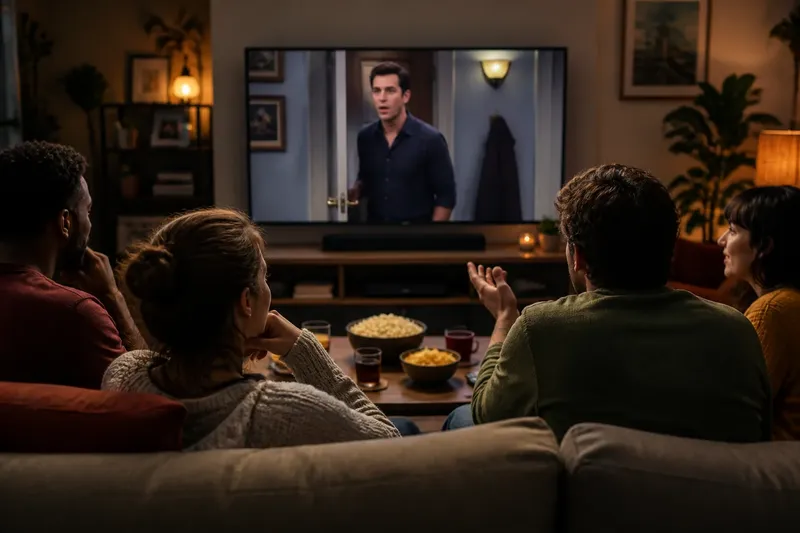
The usual mistake at a running-gag watch party is to tell everyone to spot every recurrence. The evening turns into a quiz, and guests watch the host instead of the show. Offer one loose thread to follow, with no score and no requirement to catch every appearance.
The point is not to prove that a joke has returned. It is to notice what the return does: perhaps a familiar phrase becomes more anxious, a prop changes hands, or an interruption arrives at the least helpful moment. Plan a small gathering around that shift, and leave enough quiet for the episode to remain an episode rather than a seminar with snacks.
What makes a running gag worth following?
A recurring comic idea can be a gesture, a setting, a character’s habit, a sound cue, a costume detail or a predictable failure. The useful question is what changes around it. A repetition may become more revealing because the audience knows the pattern while the character does not; it may also shift meaning as relationships or stakes change.
Choose a show and a gag that guests can follow without extensive preparation. A familiar sitcom might offer an obvious catchphrase, while a sketch series might return to one character or situation. Look for enough variation to invite conversation, but not so much backstory that guests need a guidebook. If the pleasure depends on recognising an obscure reference, the group may spend more time catching up than watching.
Pick a short run of episodes or a few connected segments rather than trying to cover an entire series. The aim is to compare a handful of appearances, not account for every one. If the recurrence is easy to find, tell guests the general thread. If finding it is part of the fun, describe what to notice without naming the exact moment.
How can you keep the preparation simple?
Several days beforehand: Choose the programme, the recurring idea and a viewing length that suits the group. Check that the relevant episodes are available through the service you plan to use, then decide whether to watch in order. A sequential run makes changes easier to notice; selected episodes can work if the gag appears in a clear, self-contained way.
Send an invitation that explains the tone: this is a shared watch, not a test of recall. Say whether guests can arrive without knowing the programme. Ask about access needs and practical preferences, such as captions, volume or a break. These details are easier to settle in a message than across the room while the opening scene is under way.
The day before: Make a short note of where the recurring idea appears and how each appearance differs. Use it as a pacing prompt, not a script. A few words per scene will do: “phrase becomes an excuse”, “prop is now missing”, or “other character anticipates it”. Leave the interpretation open. Guests may notice something less obvious, which is usually more interesting than hearing the host read out their own notes.
Arrange the room so everyone can see the screen without turning a chair into an architectural negotiation. Keep food and drinks within reach but away from the main route through the room. A sofa, a couple of chairs, a bowl of crisps and a clear path to the door are quite sufficient. A watch party does not need a theme table that could be mistaken for evidence.
What should happen during the evening?
As guests arrive: Give a brief introduction. Name the recurring idea and say that noticing it is optional; nobody needs to call out each appearance. If the gag is a surprise, offer a broad prompt such as “watch for the repeated interruption” rather than identifying its first appearance. Let late arrivals settle before starting, and recap only what they need to follow the next scene.
During the first episode or segment: Watch without pausing to explain. The first return often establishes the pattern, and guests need room to work out what kind of joke they are seeing. If someone comments, let the conversation breathe, then restart when the group seems ready. There is no need to turn every laugh into a discussion prompt. Silence does not mean the room has failed its assignment.
Between episodes: Take a short pause and ask one open question: “Did it feel different the second time?” That invites attention to timing, delivery, context or audience expectation without asking anyone to recall a detail on demand. Guests can answer, disagree or reach for a drink. A recurring joke is a thread, not a password.
Imagine you have chosen a sitcom in which one character repeatedly tries to make an ordinary announcement and is interrupted by the same doorbell. At the start, the bell simply cuts off the line. You watch a few connected episodes, pause between them and ask whether the interruption feels different later. In the last episode, another character starts speaking over the bell, and the would-be speaker anticipates it but still loses their place. The result is a conversation about a changing pattern: the bell has become a sound cue and a small sign of how the group treats that character. Nobody needs to count every chime.
Halfway through: Check the room rather than the schedule. If people are absorbed, continue; if attention is wandering, offer a break or stop after the current segment. A planned ending is more useful than another episode played from obligation. Keep the option to finish early visible from the start.
What do guests often ask about a running-gag watch party?
How many episodes should we choose?
Choose enough material for the recurrence to change, but not so much that the gathering becomes a viewing marathon. A few connected episodes or a handful of short segments can provide a clear arc while leaving room for conversation.
Should everyone know the show beforehand?
No, provided the selected material makes sense without detailed backstory. Give newcomers the minimum context needed to follow the characters, then let the programme establish its own rhythm.
Is it all right to pause for discussion?
Yes, but pause sparingly and make the conversation easy to decline. A break between episodes often preserves the comic timing better than stopping in the middle of a scene.
What if the group notices different things?
Let different readings sit alongside one another. A recurring gag can signal a character’s habit, expose a change in the group or simply work as a well-timed return; disagreement need not be resolved for the joke to land.
How can the ending avoid becoming a verdict?
After the final selection, invite one loose comment: which return felt most changed, or did the pattern become easier to predict? Keep the question about the viewing experience, not about who paid the closest attention. If the group wants to keep talking, follow the conversation. If the programme has said what it needs to say, let the evening end without a formal round of answers.
For another running-gag watch party, note what made this one comfortable: the amount of material, the invitation’s wording, whether the break came at a natural point, and whether newcomers could join in. Change only what seemed to get in the way. The phrase running-gag watch party is a useful description of the plan: choose a repeated comic idea, give it room to develop, and let guests notice at their own pace.
That last choice matters more than a clever prompt. A running gag depends on recognition, but a group does not need to announce every recognition aloud. Leave the recurring idea on screen long enough to do its work, and the room can enjoy both the joke and the small difference in how it lands the next time.